
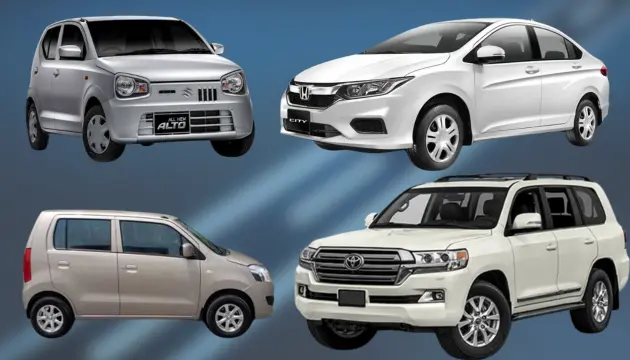
ISLAMABAD: The Tariff Policy Board (TPB), led by Commerce Minister Jam Kamal Khan, has approved the commercial import of five-year-old used vehicles with an additional 40 percent duty, despite strong opposition from Pakistan’s local auto industry.
Sources in the Commerce Ministry told private media that the decision will now be sent to the Economic Coordination Committee (ECC) this week for final approval.
The TPB includes representatives from the Ministries of Commerce, Industries and Production, Finance Division, and the Federal Board of Revenue (FBR). The issue of allowing the commercial import of used cars was discussed in two consecutive meetings before the final approval was given.
IMF Conditions on Tariff Reduction
Pakistan has agreed with the International Monetary Fund (IMF) to gradually reduce tariffs on commercially imported used vehicles by 10 percent each year, starting from 40 percent in FY 2025-26.
Under the IMF’s Extended Fund Facility (EFF), Pakistan must remove all restrictions on the commercial import of used vehicles by the first quarter of FY 2026. Initially, this policy will apply only to cars less than five years old that meet minimum environmental and safety standards. From July 2026, the age limit will be completely lifted.
— ALSO READ —
Prime minister announces relief package for flood victims
The TPB proposal states that used vehicles under PCT 8703 will be allowed for commercial import, provided they meet environmental and safety requirements set by the Ministry of Industries and Production or other relevant authorities.
Local Industry Strongly Opposes Decision
Pakistan’s auto industry has strongly opposed this move, warning that it could harm local manufacturing and lead to de-industrialization.
In a statement, the industry highlighted that Pakistan’s auto sector represents 13 global brands, including Toyota, Honda, Suzuki, and Hyundai, with 1,200 auto parts manufacturers and 1.5 million direct and indirect jobs. It has attracted investments of around $5 billion in facilities, technology, and tooling.
Pakistan is among the only 16 countries worldwide that produce all four segments of vehicles — cars, trucks, buses, tractors, and motorcycles — despite having low production volumes.
The industry warned that opening the market for unrestricted used car imports could destroy this achievement. It cited examples from Africa and small Pacific nations, where similar policies have led to the collapse of local industries.
—- ALSO READ —-
Pakistan introduces first AI-based driving test car
Planned Tariff Cuts Raise Concerns
The government’s National Tariff Policy, supported by the IMF and World Bank, seeks to reduce overall tariffs over five years.
Planned changes for the auto sector include:
-
Custom duties reduced from the current 50–100% to a flat 15%.
-
Regulatory duties — currently as high as 90% — to be cut to zero within five years.
-
Additional custom duties reduced from 7% to zero in four years.
The local industry fears that these drastic cuts, combined with open imports, will discourage local production and increase dependence on foreign-made cars.
Illegal Used Car Imports and FATF Concerns
Currently, used car imports are only allowed for overseas Pakistanis. However, this rule is often misused for commercial purposes, leading to illegal transfers of money abroad through Hundi and Hawala systems, which harms Pakistan’s financial credibility.
The Financial Action Task Force (FATF) has also placed the used car business under watch for potential money laundering (ML) and terror financing (ATF) risks.
The auto industry has submitted proposals to the government for regulating used car imports, based on international best practices, including models followed by Australia and New Zealand, where strict environmental and safety checks are enforced at multiple stages.