

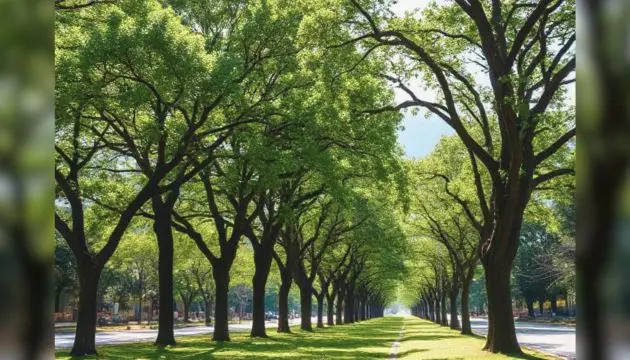
ISLAMABAD: The Capital Development Authority (CDA) informed the Islamabad High Court (IHC) that paper mulberry trees in the federal capital were cut on the directives of the Prime Minister’s Office (PMO).
In its reply submitted to the court, the CDA said that any change in the city’s master plan falls under the authority of the federal government and that the plan has been amended several times with official approval.
The CDA told the court that under planning rules, it is required to keep at least eight per cent of the city area green. It added that Islamabad’s greenery is already above this required level.
The ongoing tree-cutting campaign has sparked strong public debate in recent days. The issue has also created differences within the ruling coalition, as political parties and civil society groups raised concerns over the removal of trees.
Earlier in January, the Islamabad district administration said the campaign was focused only on paper mulberry trees, which it said were causing serious health problems, especially pollen allergies, in the city.
According to the CDA, nearly 30,000 paper mulberry trees have been removed over the past year. This includes about 8,700 allergy-causing trees cut to reduce the severity of pollen allergy in Islamabad.
ALSO READ
KP CM, PM Shehbaz hold talks on terrorism and governance
Last month, the IHC suspended the tree-cutting drive and directed all concerned departments to submit a detailed, clause-wise reply along with complete reports.
Minister of State for Interior Talal Chaudhry said that only allergy-causing paper mulberry trees were removed. He added that 60,000 new trees will be planted by the end of March, in addition to more than 40,000 mature trees already planted in the capital.
In its response to the court, the CDA said paper mulberry trees were removed because scientific studies have proven that they cause pollen allergies, asthma and other health issues.
The authority said harmful paper mulberry trees were cut and replaced with environment-friendly species. It added that paper mulberry does not help reduce pollution and instead worsens air quality by increasing the Air Quality Index (AQI).
The CDA also reminded the court that in 2022, the IHC had ordered the formation of an environmental committee. In 2023, the committee decided to remove paper mulberry trees and replace them with suitable, environment-friendly plants.
The CDA said the action was taken in line with recommendations of experts appointed by the Supreme Court.
It further said that the PMO took notice of a column written by journalist Saleem Safi in 2024 and directed the Ministry of Health and the CDA to take preventive steps to address the pollen problem.
The authority also informed the court that a large area along Islamabad Highway is covered with paper mulberry trees. It said the federal government has approved the construction of a monument to commemorate “Marka-e-Haq” — Pakistan’s armed conflict with India in May 2025 — in DHA Phase-VIII, Islamabad.
ALSO READ
Govt increases diesel price, keeps petrol unchanged till Feb 15
The CDA said the land for the project has been transferred to the Ministry of Planning and Development, and plants from the area were shifted to other locations, including Shakarparian.
Pollen concern
The federal government launched a comprehensive campaign in the last quarter of 2024 to tackle the long-standing problem of seasonal pollen allergies in the Islamabad Capital Territory (ICT).
The campaign was started after a directive from the prime minister, who declared the pollen issue a priority due to its serious impact on public health.
A clear action plan was finalised during a high-level meeting held on November 27, 2024, chaired by Minister of State for National Health Services Dr Mukhtar Ahmad Malik.
Under this plan, the CDA was directed to remove allergenic tree species, especially paper mulberry, and submit regular progress reports.
The Ministry of Health, in coordination with the CDA, adopted a scientific three-step method to fully remove the trees. This included cutting the tree, uprooting the roots completely, and refilling the soil to stop regrowth.
As a result, 29,115 allergenic paper mulberry trees were removed from different parts of the capital. The campaign targeted only the invasive paper mulberry species.
The authorities clarified that no indigenous or non-allergenic trees were harmed during the operation. Restoration work is now under way, focusing on planting suitable and environment-friendly trees in place of the removed paper mulberry trees.