


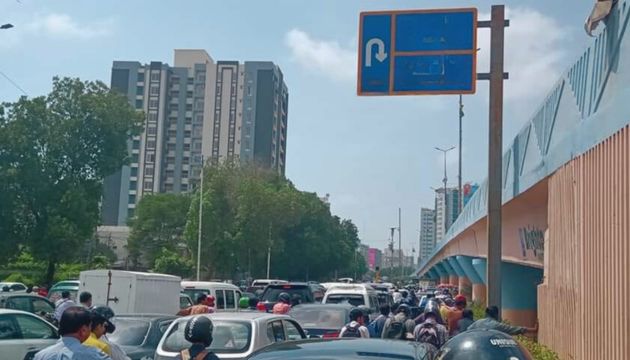
KARACHI: The newly introduced traffic rules and automated challan system have sparked public debate in the city. According to a newspaper report, the main goal of the new system is to reduce or completely end direct interaction between citizens and traffic police.
DIG Traffic Syed Pir Muhammad Shah shared these details while speaking at a programme organised by the Urban Resource Centre (URC) on Tuesday evening. The event was chaired by renowned town planner and architect Arif Hasan.
Explaining the background, the DIG said that after November 2024, road accidents in Karachi sharply increased, raising serious concern. “We needed to find the root cause behind the rising accidents,” he said. He added that complaints of police misconduct and bribery were also common, which highlighted the need for reforms.
Mr Shah said Karachi has around seven million vehicles but only 5,000 traffic policemen. “If people already criticize us with 5,000 officers, imagine what they’d say if we doubled the number. Increasing staff is not the solution,” he remarked.
ALSO READ
FBISE introduces new grading system for matric, intermediate students
He explained that the solution lies in minimising contact between citizens and police officers. “It was possible only through automation. Worldwide experience shows that the more police directly engage with the public, the more unpopular they become,” he said.
The DIG said the automated challan system began on October 1. Under the new rules, no police officer is allowed to stop vehicles at intersections. “This saves time, reduces complaints about police behaviour, and helps control accidents,” he said.
According to a newspaper report, the Karachi Road Accident Analysis Team found that over-speeding, overloading, and motorcycle accidents are the leading causes of road deaths. “Every second victim of a road crash is a motorcycle rider. Out of 90 deaths per month, 45 to 50 are motorcyclists — mostly because they don’t wear helmets,” Mr Shah added.
ALSO READ
Senate panel slams uncontrolled fee hikes by private schools in Islamabad
He said the department has made it mandatory for heavy vehicles to install tracking devices to control their speed. “If transporters fail to install trackers, they face a Rs100,000 fine,” he said, adding that 12,000 of the 22,000 heavy vehicles in Karachi have already complied.
Speaking at the event, Arif Hasan said the new automated system demands a cultural change in Karachi, which will take time. He stressed the importance of policy continuity and urban reorganisation. “Traffic management and infrastructure go hand in hand,” he said.
He also suggested that traffic education should begin at the primary school level. “You have taken a major step by introducing automation, but public opinion must also be considered,” he concluded.
The event ended with a question-and-answer session attended by citizens and experts.